Mission Definition Review: SR-1
Document Ref: OMSA-SR-1-MDR
Program: Early Sounding Rockets
Vehicle: Skybreaker I
Target Launch: February 1951
1. Mission Overview
1.1 Strategic Context
SR-1 "First Spark" is the first launch of the new agency, laying the foundations for the Early Sounding Rockets campaign -
and aiming to complete the first contract in the Early Sounding Rockets program.
It will be the first test of the Skybreaker I vehicle and, if the launch is successful, will gather initial pressure/temperature data from the lower atmosphere and validate our aerodynamic models for future high-altitude Kármán line attempts.
This mission aims to complete the contract for "First Flight".
1.2 Mission Objectives
Objectives are tiered to allow for partial mission success analysis.
| Serial | Objective | Source |
|---|---|---|
| 1 | Reach the desired altitude and climb rate requirements. | Contract |
| 2 | Validate the sounding rocket performance model for use in future missions. | OMSA Engineering |
| 2 | Gather low atmosphere Earth science and test the instruments | OMSA Science |
2. Requirements & Constraints
2.1 Trajectory and Attitude Control
| Serial | Requirement | Type | Source |
|---|---|---|---|
| 1.1 | The vehicle must reach a maximum altitude of at least 1000 m. | Threshold | Contract |
| 1.2 | The vehicle should reach a maximum altitude of at least 15,000 m. | Goal | OMSA Engineering |
| 1.3 | The vehicle should reach a maximum rate of climb of at least 50 m/s. | Threshold | Contract |
| 1.4 | The trajectory must only take the vehicle over unpopulated areas. | Threshold | Range Safety |
2.2 Payload & Science
| Serial | Requirement | Type | Source |
|---|---|---|---|
| 2.1 | Temperature measurements should be made in-flight in the low atmosphere. | Goal | OMSA Science |
| 2.2 | Barometer measurements should be made in-flight in the low atmosphere. | Goal | OMSA Science |
| 2.3 | The payload should transmit scientific data back to the ground while in flight. | Goal | OMSA Science |
2.3 Power & Avionics
| Serial | Requirement | Type | Source |
|---|---|---|---|
| 3.1 | Battery capacity must be sufficient for the entire mission. | Threshold | OMSA Engineering |
| 3.2 | Avionics must be sufficient to allow reading of payload instrument data and basic telemetry | Threshold | OMSA Engineering |
3 Preliminary Analysis
The preliminary analysis will be used as a basis for the design of the 'Skybreaker I' vehicle and will cover the following:
- Delta-V Requirements
- Flight Time Estimate
- Power Budget
In this analysis we make the following assumptions:
3.1 Delta-V Requirements
To estimate the required performance, we equate the kinetic energy at burnout to the potential energy at apogee, accounting for losses during the powered ascent.
combined with:
results in:
where is the altitude above ground level, is the engine burn time, is the proportion of the propellant's delta-v that is 'lost' to drag, and is the gravitational constant.
When the propellant Delta-V required is plotted against the target height, with a of 50s (assuming an early generation Aerobee engine) the following graph is produced.
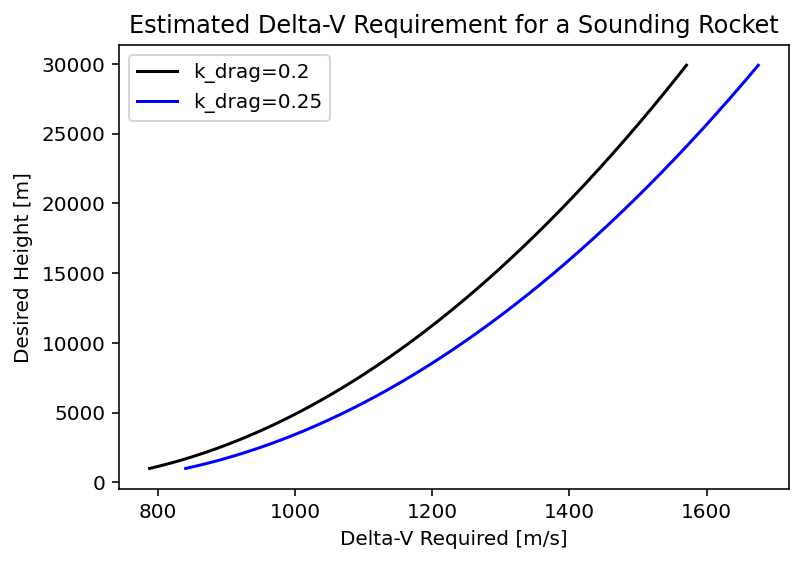
Assuming is 0.2, the Delta-V required is estimated to be
3.2 Flight Time Estimate
The flight time is required in order to size the power subsystem and will be estimated by combining the burn time, coast time, and fall time, assuming drag is negligible.
where (an empirical assumption) and (from SUVAT).
If , , and then seconds.
3.3 Power Budget
If the above flight time is taken, with a safety factor of 2, and an initial assumption of a power consumption of 100 W, the required energy storage is:
3. Concept of Operations
The mission profile consists of five distinct phases:
-
Phase 0: Pre-Launch - Confirm all systems are functioning correctly.
-
Phase I: Launch - Engine ignition, clamp release, and spin-stabilization.
-
Phase II: Unpowered Ascent (Coast) - Immediately following burnout (~T+50s) the vehicle coasts to apogee.
-
Phase III: Apogee - Maximum altitude is reached.
-
Phase IV: Descent - Unpowered and uncontrolled descent.
4. Risk Register
| Serial | Risk | Mitigatation | Severity |
|---|---|---|---|
| 1 | Uncontrolled catastrophic failure (explosion) | All personnel to be clear of pad. | High |
| 2 | Engine failure | Engines are static tested prior to flight. | Medium |
| 3 | Debris striking personnel or structres | Vehicle to be launched at a small angle towards the sea. Range safety device to be installed if possible. | Medium |